

TL;DR: Eloping in the Azores means exchanging vows in one of the most dramatic natural settings in Europe, surrounded by volcanic lakes, hydrangea cliffs, and Atlantic coastlines. Most foreign couples skip the local legal process entirely and do their paperwork at home, keeping the ceremony in the Azores purely symbolic (and stress-free). If you want a legally binding ceremony here, you’ll need documents submitted at least 30 days in advance. Either way, the planning window is typically 3 to 6 months, and having a local planner on the ground makes a bigger difference than most couples expect.
The Azores keep appearing on elopement photographers’ blogs, destination guides, and social media feeds, and it’s not hard to see why. Nine volcanic islands scattered across the Atlantic, with crater lakes, thermal springs, black sand beaches, and coastlines that look like they belong in a different century. It’s one of the few places in Europe where you can have a genuinely remote ceremony without flying to the other side of the world.
But planning an elopement here from abroad involves more moving parts than most couples anticipate. The legal side alone confuses a lot of people. Add vendor coordination, location scouting, and island logistics, and it’s easy to feel overwhelmed before you’ve even booked flights. This guide covers everything you need to know: the legal requirements for foreign couples, a realistic planning timeline, ceremony ideas that actually make use of what the Azores offers, and an honest look at what goes wrong when couples try to do it without local help.
How to legally get married in the Azores as a foreign couple
Foreign couples can legally marry in the Azores without being residents of Portugal. You don’t need property here, a local address, or a relative living in the country. What you do need is a set of official documents submitted to the Civil Registry Office (Conservatória do Registo Civil) at least 30 days before your ceremony date.
The required documents are:
- Valid passports for both partners
- Original or certified copies of both birth certificates
- An Affidavit of Marital Status (confirming both parties are free to marry, obtained from your consulate or embassy)
- A Marriage License Application submitted to the local Civil Registry Office
- Two witnesses over the age of 18
All foreign documents must be translated into Portuguese by a certified translator and may require an Apostille stamp depending on your country of origin. The actual ceremony must also be conducted in Portuguese, which is something many couples don’t realise until late in the planning process.
Because of this, the approach most couples take is to handle the legal paperwork back home and keep their Azores ceremony symbolic. A symbolic ceremony has no legal bureaucracy attached to it, can be conducted in any language, and gives you full creative control over the setting, officiant, words, and format. You get all the romance of eloping in the Azores without coordinating certified translations from abroad. Our complete Azores wedding guide covers this in more detail if you want to weigh up the options.
One important note for LGBTQ+ couples: same-sex marriage has been legal in Portugal (including the Azores) since 2010, and there are no additional requirements beyond those listed above. The Azores is a genuinely welcoming destination for gay and queer weddings, not just on paper.
Azores elopement timeline: what to plan and how far in advance
Most couples underestimate how much lead time an Azores elopement needs. Even for two people with no guests, the logistics stack up quickly: venue availability, vendor bookings, document preparation, flights, accommodation, and the legal filing window if you’re going the legally binding route. Here’s a realistic breakdown.
| Timeframe | What to sort out |
|---|---|
| 6 months out | Choose your island and general date window. Research ceremony locations. Start talking to local planners. Book flights early, especially for peak season (June to August). |
| 4 to 5 months out | Lock in your ceremony location and planner. Book photographer and any other vendors (florist, officiant, hair and makeup). Reserve accommodation. |
| 3 months out | If doing a legal ceremony in the Azores, begin gathering documents and arrange certified translations. Start the affidavit process with your consulate. |
| 6 weeks out | Submit all legal documents to the Civil Registry Office (required minimum for a legally binding ceremony). Confirm all vendor details and timelines. |
| 2 to 3 weeks out | Final check-in with your planner. Confirm logistics for the day: transfers, timing, any permits needed for your ceremony location. |
| Day of | Show up. Everything else should already be handled. |
If you’re planning a symbolic ceremony (which most couples do), you can compress the legal document steps entirely. The 3 to 4 month window is usually enough. That said, peak season dates on São Miguel fill up faster than people expect. If you have your eye on a specific date in June, July, or August, 6 months is the safer target.
Off-season elopements (October through April) have real advantages: fewer tourists at ceremony locations, lower accommodation prices, and more vendor availability. The weather is wetter and more variable, but the landscapes are arguably greener and more dramatic. Some of the most beautiful elopement photos we’ve seen from the Azores were taken in November.
Unique ideas for your Azores elopement ceremony
The Azores gives you backdrops that most destinations simply can’t match. The question is how to use them well rather than defaulting to the same viewpoints every travel photographer already knows. Here are ideas that actually take advantage of what makes these islands different.
Ceremony at a crater lake
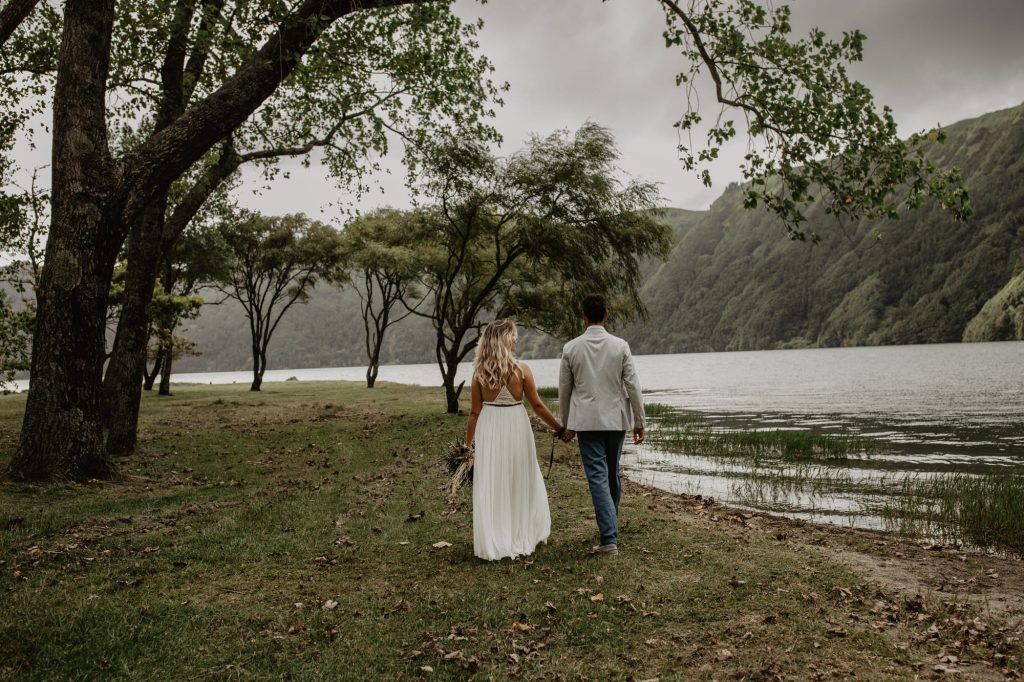
Sete Cidades and Lagoa do Fogo are the two most iconic crater lakes on São Miguel, but they’re very different experiences. Sete Cidades has twin lakes of different colours (one green, one blue depending on the angle and light) and a small village inside the caldera. Lagoa do Fogo sits higher, is often wrapped in mist, and has a wilder, more untouched feel. Both work beautifully for a ceremony, but Lagoa do Fogo tends to photograph better for couples who want drama over pastoral charm.
Thermal valley vows at Furnas
The Furnas valley is unlike anywhere else in Europe. Steam rises from the ground, the air smells of sulphur, and the whole landscape has an otherworldly quality that no filter can replicate. A ceremony at the edge of the thermal pools or in the Terra Nostra botanical gardens (which adjoin the valley) is genuinely unforgettable. Pair it with a soak in the iron-rich thermal pool afterwards and it becomes a full sensory day.
Clifftop ceremony on the north coast
São Miguel’s north coast is significantly less visited than the south. The cliffs at Miradouro da Ponta do Escalvado or along the road between Nordeste and Ribeira Grande offer dramatic Atlantic views with almost no foot traffic. These spots require a local guide to access safely and to identify the right window in terms of light and weather, but the payoff is a completely private ceremony backdrop.
Private picnic after the ceremony
One thing that sets an Azores elopement apart from a standard destination wedding is the flexibility to build the whole day around just the two of you. A ceremony at a crater lake followed by a private gourmet picnic at a secluded spot nearby is one of the most popular formats we set up for elopement couples. Local produce, Azorean wines, a plush setup with no restaurant noise or other tables around. It turns a single ceremony moment into a full day experience.
Multi-island elopement
São Miguel is the most accessible island, but it’s not the only option. Pico has the most dramatic landscape in the archipelago: a single volcanic cone rising nearly 2,400 metres from the sea, surrounded by UNESCO-listed vineyards that stretch down to the coast. A ceremony on Pico followed by a few days exploring by boat or kayak makes for an elopement trip that most couples talk about for years. The logistics are more involved, but that’s what a local planner is for.
Planning your elopement in the Azores? 💍
GlamAzores is a local wedding and experiences agency based in São Miguel. We handle everything from ceremony locations and vendor coordination to private picnic setups and transfers, so you can focus on the day itself. See our full Azores elopement services or get in touch to start planning.
Why most couples regret not using a planner for their Azores elopement
Planning an elopement from abroad without local support is possible. Couples do it. But a disproportionate number of them hit the same set of problems, and most of those problems were avoidable.
The first issue is vendor reliability. The Azores is a small island system with a limited pool of professional vendors. Not all of them communicate well in English, not all of them respond quickly to international enquiries, and a few of them are simply unreliable. A local planner already knows which photographers show up prepared and which florists need three follow-ups to confirm an order.
The second issue is location access. The most photogenic spots are not always on Google Maps. Some require permits. Some are only accessible with a guide who knows the terrain. Some look incredible in photos but face the wrong direction for afternoon light. Couples who do their own research from abroad often arrive to find their chosen spot crowded, inaccessible, or nothing like the images they saved.
The third issue is the island pace. Things here run differently than in a major European city. Vendors confirm late. Deliveries arrive on island time. Weather changes by the hour. A local planner accounts for all of this in the timeline and has backup options ready when something shifts. A couple managing this from a different time zone does not.
None of this is meant to scare you off. Elopements here are genuinely joyful, low-stress affairs when the logistics are handled well. The point is that “low stress” doesn’t happen by accident. It happens because someone on the ground has already anticipated the problems before they become your problem on the morning of your ceremony.
GlamAzores has been planning elopements in the Azores for couples from Europe, North America, and beyond. We know these islands, we know the vendors, and we know where the light hits best at 5pm in September. If you’re starting to plan and want to understand what’s realistic for your budget and timeline, get in touch. The first conversation is always free.
LGBTQ+ elopements in the Azores
Portugal was the sixth country in Europe to legalise same-sex marriage, and that includes the Azores. There are no additional legal requirements for LGBTQ+ couples beyond those that apply to everyone else, and the local authorities are well accustomed to processing marriages for international couples of all genders and orientations. In practice, this means you can elope here with exactly the same options, locations, and vendors as any other couple, with no extra steps or complications. Our dedicated page on LGBTQ+ weddings in the Azores covers everything specific to queer couples planning a ceremony here.
GlamAzores was the first inclusive wedding and travel agency in the Azores. We have worked with LGBTQ+ couples from across Europe and North America and know which vendors are actively welcoming (not just technically compliant). If you want to elope somewhere that feels genuinely accepting rather than just legally permissive, the Azores delivers on both counts.
Key takeaways for your Azores elopement
Eloping in the Azores works best when you treat it as a full day experience rather than just a ceremony. The legal path is straightforward but document-heavy, which is why most couples do their paperwork at home and keep the Azores ceremony symbolic. Planning 3 to 6 months out gives you enough runway to book the right vendors and secure your preferred location. Having someone local handle the details means you actually get to enjoy the day you’ve been planning.
If you’re ready to start, explore our wedding and elopement services, read through the full Azores wedding guide, or browse the best venues across the islands. When you’re ready to talk specifics, we’re here.
Frequently Asked Questions
Can foreign couples legally elope in the Azores?
Yes. Foreign couples can get legally married in the Azores without being residents of Portugal. You’ll need to submit official documents (birth certificates, an affidavit of marital status, and a marriage license application) to the local Civil Registry Office at least 30 days before the ceremony. All documents must be translated into Portuguese by a certified translator. Many couples choose to handle the legal ceremony at home and have a symbolic ceremony in the Azores instead, which removes the paperwork requirement entirely.
How far in advance should I book an Azores elopement?
For a symbolic elopement, 3 to 4 months is usually sufficient. For a legally binding ceremony, you’ll want at least 6 months to allow time for document preparation and the mandatory 30-day filing window. If your date falls between June and August (peak season), booking 6 months out regardless of ceremony type is the safer approach, as both venues and vendors fill up quickly.
What is the best island in the Azores to elope?
São Miguel is the most practical choice for most couples. It has the widest range of ceremony locations (crater lakes, thermal valleys, cliffside viewpoints, botanical gardens), the most vendor options, and the easiest flight connections. Pico is the most dramatic alternative, with its iconic volcanic peak and UNESCO vineyards, but logistics are more involved. For couples prioritising seclusion over accessibility, São Jorge and Flores are worth considering.
Do LGBTQ+ couples have any specific requirements to marry in the Azores?
No. Same-sex marriage has been legal in Portugal (including the Azores) since 2010. The legal requirements are identical for all couples regardless of gender or sexual orientation. The Azores is a welcoming destination for LGBTQ+ elopements, and several local vendors actively work with queer couples. GlamAzores was the first inclusive wedding and travel agency in the Azores and welcomes LGBTQ+ couples across all services.
What does an Azores elopement typically cost?
Costs vary significantly depending on the services you include. A minimal elopement with a photographer and officiant is the basic package, but add a planner, florist, private picnic setup, hair and makeup, and transfers, and the budget stretches a lot more for a fully planned intimate day. Venue hire is often not required for outdoor ceremony locations, which keeps elopement costs notably lower than a full wedding.
Do I need a permit to have a ceremony at a crater lake or natural site in the Azores?
It depends on the location and the nature of the ceremony. Some protected natural areas require permits for events, even small ones. Others are freely accessible but have restrictions on setup (no decorations, no amplified sound). A local planner can identify what’s required for your chosen spot and handle any permit applications on your behalf, which is another reason having someone on the ground matters.
